
Your employees are turning your AI rollout into content. The joke is a diagnostic and the diagnosis is a missing strategy.
Spend a minute scrolling and you’ll hit one: a meme, a reaction video, a fifteen-second skit making fun of the way companies are adopting AI – the near-hysterical rush to push tools out the door with no strategy behind them and no real grasp of what they’re for. Mocking the corporate AI scramble has quietly become one of the internet’s favourite office jokes, and that is not a coincidence. It’s a signal. We pulled three of them out of the feed, each one standing in for a wider wave of the same content: two that capture how the rush is perceived from inside the company, and one that captures what it produces.
If you lead an organization, they are about you.
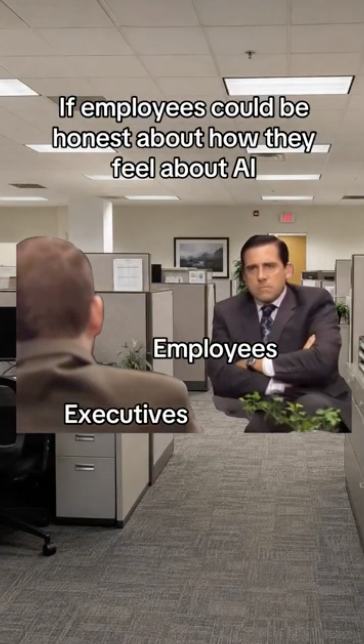
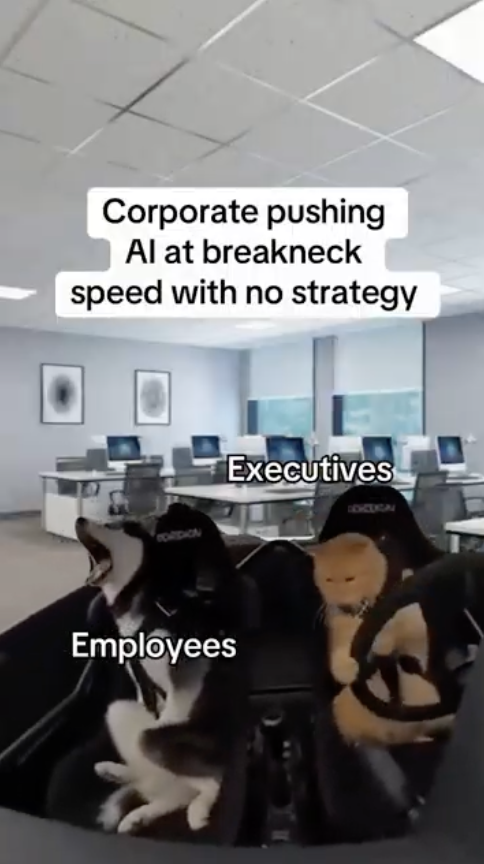
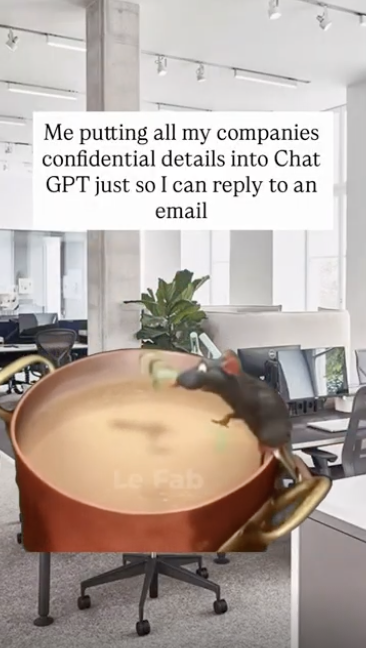
In the first, a caption reads “If employees could be honest about how they feel about AI.” Cut to the Michael Scott stare from The Office – the flat, withering look of someone who has heard the pitch, sat through the all-hands, and decided it is not worth saying out loud. On one side, the executives. On the other, the employee, holding a silence that says everything the caption promises and the room never hears. In the second, “Corporate pushing AI at breakneck speed with no strategy.” A cat is flooring a driving simulator, taking a corner at a speed no one asked for, while a husky in the passenger seat screams. The cat is the leadership team. The husky is your workforce, strapped in with no say over the wheel and no view of the road. In the third, “Me putting all my company’s confidential details into ChatGPT just so I can reply to an email.” It’s the rat from Ratatouille, frantically stirring a pot in the middle of the open-plan office – a whole confidential kitchen thrown together, in plain sight, to accomplish something trivial.
Three specimens from a much larger sample
It’s worth being explicit about why three jokes belong in a strategy conversation. A single meme is an anecdote – easy to wave off as one disgruntled person having a bad week. A trend is a distribution. And the variations are endless once you start noticing them: the “AI-first” leader who can’t name a single workflow it improved, the mandatory copilot nobody was trained to use, the strategy deck that is mostly stock imagery of glowing brains. When an entire content category organizes itself around the way companies roll out AI, that category stops being entertainment and becomes aggregate data about a shared condition, published by the people living inside it. The three videos are funny because they’re precise, and they’re precise because they’re describing something real and widespread. A meme this accurate is not content. It’s telemetry.
The glitch is the signal
When a generative model produces a glitch – a face that won’t resolve, a hand with too many fingers, a texture that dissolves at the edges – we don’t read it as noise. We read it as a signal about the structure underneath: what the model was trained on, what it over-represents, what it never learned to produce. The error is the moment the system tells you what it actually is, as opposed to what it was supposed to be. In a well-designed practice, that failure becomes productive: it’s how you inspect the thing.
The first cost: you are the meme now
Start with the husky. The gap between the story leadership tells about AI and the experience on the floor is not a vibe, it is measured, and it is widening fast. In Writer’s 2026 enterprise AI survey, employee confidence in their own company’s AI strategy fell from 47% to 31% in a single year. In the same research, three out of four C-suite respondents admitted their AI strategy was “more for show” than a working internal guide – built, in their own telling, for investors and press. Nearly seventy percent said their company was already carrying out AI-linked layoffs while that strategic foundation was still missing. Read those numbers next to the meme and the joke stops being a joke. When a leader stands up and says “we’re AI-first” without a route, a purpose, or a plan, they are not projecting vision. They are confirming the husky’s suspicion that the cat has no idea where the car is going – and doing it at speed.
The first meme adds a second, quieter layer to this – the silence itself. The whole gag is that the honest reaction stays inside the employee, unspoken, because the room isn’t safe for it. That, too, is measured. In the Writer survey, ninety percent of executives believed employees felt safe reporting unethical or dangerous AI behavior without fear of reprisal. The employees, by and large, did not. So the feedback that should be arriving as a flagged incident in a governance channel arrives instead as a reaction video for strangers, because that is the only channel that feels open. Michael Scott’s stare is what a broken feedback loop looks like from the outside.
This is the credibility cost, and it does not stay contained to the tool. Skepticism about an unplanned rollout metastasizes into skepticism about the leadership doing the rolling out – and, eventually, leaks outward, into how clients and the public read your brand when the output starts to look like everyone else’s undercooked, unmistakable AI content. The first two videos are the same warning shot fired twice: your workforce has already reviewed your AI strategy, and the review is a screaming dog in a passenger seat.
The second cost: no kitchen in the building
The instinct is to see the third video as a discipline problem – reckless employees leaking data to save five minutes. That reading is comforting and wrong. The rat is not reckless by temperament. Nobody gave it a kitchen.
Where there is no structured way to use AI, people build their own, quietly, one deadline at a time. This is shadow AI, and it is not a fringe behavior at the margins of your org. Depending on which 2025-2026 study you read, somewhere between half and eighty percent of employees are already using AI tools their employer never approved; only around one in six report using exclusively company-sanctioned tools. One estimate put the average enterprise at roughly fourteen distinct AI tools in active use, of which IT was aware of four or five. The other two-thirds are the pot in the middle of the office that leadership can’t see.
The exposure is exactly the Ratatouille image: personal accounts, confidential ingredients, no visibility, no controls.
None of this is malice. Almost none of it is even carelessness in the ordinary sense. It is a governance vacuum being filled by the most rational tool within arm’s reach, by people who simply want to hit their deadline and were never told where the line is or given a compliant place to work. The rat is improvising a kitchen because the alternative was to fail the task.
The two costs are one cost
Step back and the trust gap and the shadow-AI mess turn out to be the same problem seen from two windows. Both flow from the same missing structure. The husky panics because there’s no route; the rat improvises because there’s no kitchen. Announce urgency without a plan and you get the first video. Build no structured path and you get the third. They are two symptoms of one absence. And there is a cruel symmetry in how that absence gets funded. Grant Thornton’s 2026 research found that training – the single investment that would let people use these tools well, safely, and with judgment – is the most underfunded area of AI spend, even as leaders remain far more convinced than their own operations teams that the workforce is ready to adopt. You broadcast the urgency and you starve the capability. Then you’re surprised that people are frightened, silent, and pasting confidential data into a browser tab. That is the whole genre, compressed into a budget decision.
What a strategy actually is
A strategy is not the license you bought or the sentence “we’re AI-first” delivered to a room that then files out and reopens its personal ChatGPT tabs. A real strategy is the unglamorous structure these videos are pointing at, and it has four load-bearing parts. A purpose: a specific, spoken answer to what problem, whose work gets better – so adoption has a destination and the husky can finally see the road. Governance: defined tools and data rules that people can actually follow under deadline pressure, designed to pull shadow AI into the light rather than a blanket ban that only buries it deeper. Literacy: enough real training, tied to actual workflows, that people know when to trust an output and when to check it – the whole difference between using the tool and being used by it. And a culture in which the honest reaction from the first video can be said in a room, to a person, and acted on – instead of encoded into a reel because that felt like the only safe place to put it.
No, none of these is a technology purchase. All of them are decisions about people, incentives, and clarity – which is precisely why they get skipped in favor of buying the platform and announcing the initiative.
The platform is the easy part. It was never the strategy.
The meme is a free diagnostic – an unusually honest one – delivered by the people best positioned to run the test. The question is whether you would rather write the strategy yourself – purpose, governance, literacy, culture, in that order – or keep reading it back to yourself in the comments.
Turning the joke back into a plan is the work we do at Immanence: helping organizations build the structure underneath the rollout, so the story leadership tells about AI and the one employees live are finally the same story.
